Niacin in MemoHoney: Food Sources First, Then the 7.5 mg Capsule
Quick answer
MemoHoney lists 7.5 mg NE of niacin (47% DV), about half the 14 to 16 mg adults need and roughly what one serving of chicken, beef or fish provides. Most Americans already get enough from food. Flushing starts around 30 mg of nicotinic acid, so it is unlikely. The label does not say which form is used.

What foods have niacin and vitamin B3? Start with your plate
Everyday foods do most of the work. The NIH Office of Dietary Supplements says niacin occurs naturally in many foods, is added to others, and that most people in the United States get enough from what they eat (NIH ODS, Niacin (consumer)).
| Kind of food | What the NIH names | Niacin per serving | In the brand food photos |
|---|---|---|---|
| Animal foods | Poultry, beef, pork and fish | About 5 to 10 mg for many, such as poultry, beef and fish | Raw beef and chicken; shrimp, which is shellfish rather than fish |
| Plant foods | Some nuts, legumes and grains | About 2 to 5 mg | Dried beans in both photos; peanuts and hazelnuts |
| Foods with niacin added | Many enriched or fortified breads and cereals | Varies; the added form is well absorbed | Not shown |
| Protein with tryptophan | Turkey: 3 oz of breast meat has about 180 mg tryptophan | Could equal about 3 mg | Not shown |
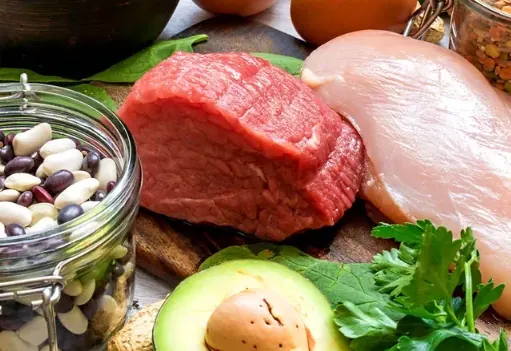
Compare one serving with one capsule. A portion of chicken, beef or fish carries about 5 to 10 mg, which brackets the 7.5 mg in MemoHoney. Grains are a weaker source unless enriched, since the NIH says natural niacin in some grains is only about 30% available to the body (NIH ODS, Niacin (health professional)).
For readers over 50 who eat some meat, fish, beans or fortified cereal most days, the capsule's niacin mostly repeats what the plate already provides.
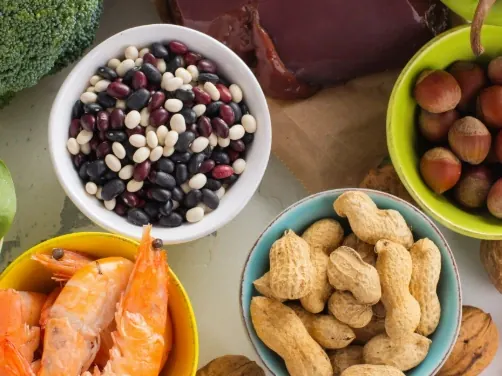
Plant eaters have options too. Beans, peanuts and other legumes, plus some nuts and whole or enriched grains, add up across a day.
There is no honey in either photo, and none in the capsule. The MemoHoney name refers to the brand, not to an ingredient. Our foods for memory guide widens this food-first view.
How does 7.5 mg NE compare with what adults over 50 need?
It is about half of one day's need. The NIH sets the adult RDA at 14 mg NE for women and 16 mg NE for men from age 19 on, so the same targets hold at 55 or 80. The label's 47% DV is measured against 16 mg (NIH ODS, Niacin (health professional)).
NE stands for niacin equivalents. The unit also credits the niacin your body makes from tryptophan, an amino acid in protein foods, at roughly 60 mg of tryptophan for each 1 mg of niacin. Here is where the capsule sits:
| Benchmark | Applies to | Niacin per day |
|---|---|---|
| Average from food and drinks | US men | 31.4 mg |
| Average from food and drinks | US women | 21.3 mg |
| Recommended Dietary Allowance | Men 19 and older | 16 mg NE |
| Recommended Dietary Allowance | Women 19 and older | 14 mg NE |
| Daily Value used on labels | Adults | 16 mg |
| Roughly enough to prevent pellagra | Adults | about 11 mg NE |
| Upper limit from supplements | Adults | 35 mg |
| One MemoHoney capsule | Label serving | 7.5 mg NE |
The average intakes matter most here. Typical American diets already pass the RDA before any capsule, which is why 7.5 mg is a top-up rather than a fix. The full panel is printed on our supplement facts page.
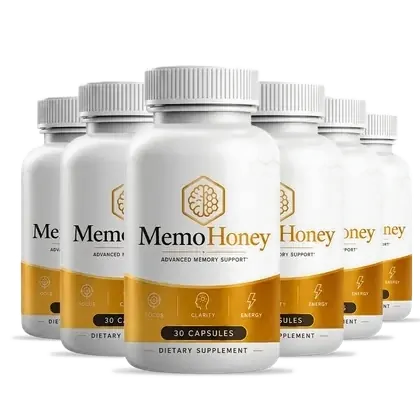
The 6-bottle box is the cheapest way to buy MemoHoney.
$49 per bottle with the 6-bottle box, $294. Refunds within 60 days · 3 or 6 ship free · BuyGoods secure payment.
Niacin flush: at what dose does it start?
Almost certainly not. According to the NIH, flushing usually appears once nicotinic acid reaches 30 to 50 mg or more, so the capsule would need to be four times stronger just to reach the bottom of that range (NIH ODS, Niacin (health professional)).
The flush itself is redness with burning, tingling or itching across the face, arms and chest, sometimes with headache, rash or dizziness (NIH ODS, Niacin (consumer)). Follow the ladder from one capsule up:
- 7.5 mg
One MemoHoney capsule
About half an adult's daily need. No flush expected.
- 11 mg
Deficiency guard
Roughly what keeps pellagra away, per the Linus Pauling Institute.
- 14 to 16 mg
Adult RDA
Women 14 mg NE, men 16 mg NE. Average US diets already pass it.
- 30 mg+
Flushing begins
Nicotinic acid from this level up typically reddens and warms the skin.
- 35 mg
Upper limit
The most adults should take from supplements daily, set to prevent flushing.
- 1,500 mg
Prescription range
Doses like this can raise blood sugar. Nothing in this capsule comes close.
Add up your other bottles too. The NIH notes that multivitamin and mineral products contain niacin, and the 35 mg limit counts every supplement together (NIH ODS, Niacin (consumer)).
Which form of niacin does MemoHoney use?
Neither the label nor the brand pages say. The panel just reads "Niacin", a name that fits either form. The NIH says the two main forms in supplements are nicotinic acid and nicotinamide (NIH ODS, Niacin (consumer)).
At 7.5 mg the answer matters little. Nicotinamide, also sold as niacinamide, does not cause flushing, and the Linus Pauling Institute calls it the better-tolerated form (Linus Pauling Institute, Niacin). Nicotinic acid only flushes from about 30 mg up.
- Printed on the label
- Niacin 7.5 mg NE, 47% DV
- Form named
- No, on the label or the brand pages
- Flushing likely
- No, whichever form it is
- Brand sales page
- Headed "Niacina", the Portuguese spelling
- Not to be confused with
- Nicotine, an unrelated substance
Can niacin help memory loss?
Only when the memory problem comes from a severe shortage. The Linus Pauling Institute lists memory loss among the signs of pellagra, the disease of deep niacin deficiency, next to headache, apathy, tiredness, low mood and confusion (Linus Pauling Institute, Niacin).
Neither NIH fact sheet covers niacin for memory, cognitive decline or dementia in people who eat enough. NCCIH, the NIH's complementary health center, reports that taking B vitamins for a short time has not improved thinking in older adults (NCCIH, 7 Things To Know About Supplements and Alzheimer's).
Should you ask a pharmacist before adding this niacin?
Most people can answer that in four taps. The questions below cover the niacin points in the NIH fact sheets and the caution printed on the label:
Niacin check
Do you already take a multivitamin, a B-complex or another product with niacin?
Has a doctor prescribed niacin for you at high doses?
Do you take isoniazid or pyrazinamide for tuberculosis?
Are you pregnant, nursing or under 18, or do you have a known medical condition?
Answer every question to see your result. Nothing is saved or sent.
None of the niacin points applies to you. 7.5 mg sits well inside normal daily intake. The arginine in the same capsule has cautions of its own, listed on the side effects page.
Show the label to your pharmacist or doctor. They can total your niacin against the 35 mg limit, check tuberculosis drugs that lower niacin levels, and apply the label's advice for pregnancy, nursing, under-18s and medical conditions.
Stop and ask your doctor before taking it.
The bigger niacin warnings in the NIH pages, such as blood sugar changes at 1,500 mg a day or more and advice for people on statins, concern prescription-size doses, not 7.5 mg (NIH ODS, Niacin (consumer)). The full capsule is covered on our side effects page, and every label line on our MemoHoney ingredients page.
Niacin and food: questions readers ask
What foods are high in niacin and vitamin B3?
Poultry, beef, pork and fish lead the NIH list, at about 5 to 10 mg per serving for many animal foods. Nuts, legumes and grains give about 2 to 5 mg, and many breads and cereals have niacin added.
Do I need a niacin supplement if I eat meat or fish?
Most people do not. The NIH says most Americans get enough niacin from food, and average intakes from food are 21.3 mg a day for women and 31.4 mg for men, above the 14 to 16 mg adults need.
Is 7.5 mg of niacin a high dose?
No. It is a nutrient-level amount, roughly half the adult RDA and well under the 35 mg upper limit for supplements. A single serving of chicken or fish can hold about as much.
Does niacin cause flushing at low doses?
Flushing usually takes 30 mg or more of nicotinic acid, so 7.5 mg is far below it. The nicotinamide form does not cause a flush, according to the NIH.
Is niacin the same as vitamin B3?
Yes. Niacin is the common name for vitamin B3, and nicotinic acid and nicotinamide are its two main forms in supplements. It is not related to nicotine.
Can a niacin shortage cause memory problems?
Yes, in severe cases: memory loss is one sign of pellagra, the disease of deep niacin deficiency. We found no NIH or Linus Pauling page showing that extra niacin helps memory in people who eat enough.
How much niacin is too much from pills?
The adult upper limit from supplements is 35 mg a day. Add the niacin in every product you take, including multivitamins, to the 7.5 mg in MemoHoney.
What does mg NE mean on a label?
NE stands for niacin equivalents. The unit also counts niacin your body makes from tryptophan, at about 60 mg of tryptophan for each 1 mg of niacin.
Can the niacin in MemoHoney hurt my liver?
The liver warnings in the NIH fact sheet concern high-dose nicotinic acid, mostly extended-release products, not 7.5 mg. If you have liver disease, the label asks you to check with a physician first.
Page check
Written by
Reads the MemoHoney label line by line and weighs each health statement against NIH, Mayo Clinic and Alzheimer's Association guidance.
- Label re-read on October 13, 2026
- Product details: the printed label and brand pages. Health details: the sources linked in the text
- Found an error? Write to [email protected]. How we work: editorial standards