How We Check Every MemoHoney Page: Our Editorial Standards
Quick answer
Every MemoHoney fact here starts with the printed label, which lists no honey. Brand pages supply prices and policies; NIH, FDA, FTC, Mayo Clinic and the Alzheimer's Association supply the health facts. Label milligrams are compared with study grams, gaps say "not published", and unverified reviews never appear.

How do we read a MemoHoney label?
In the same five steps every time, from the front of the bottle to the small print. Copying in a fixed order means nothing gets skipped, including the parts a sales page tends to leave out.
The front panel
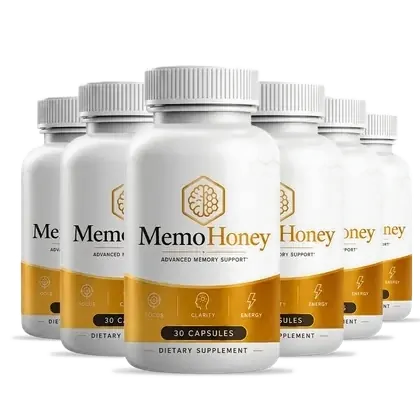
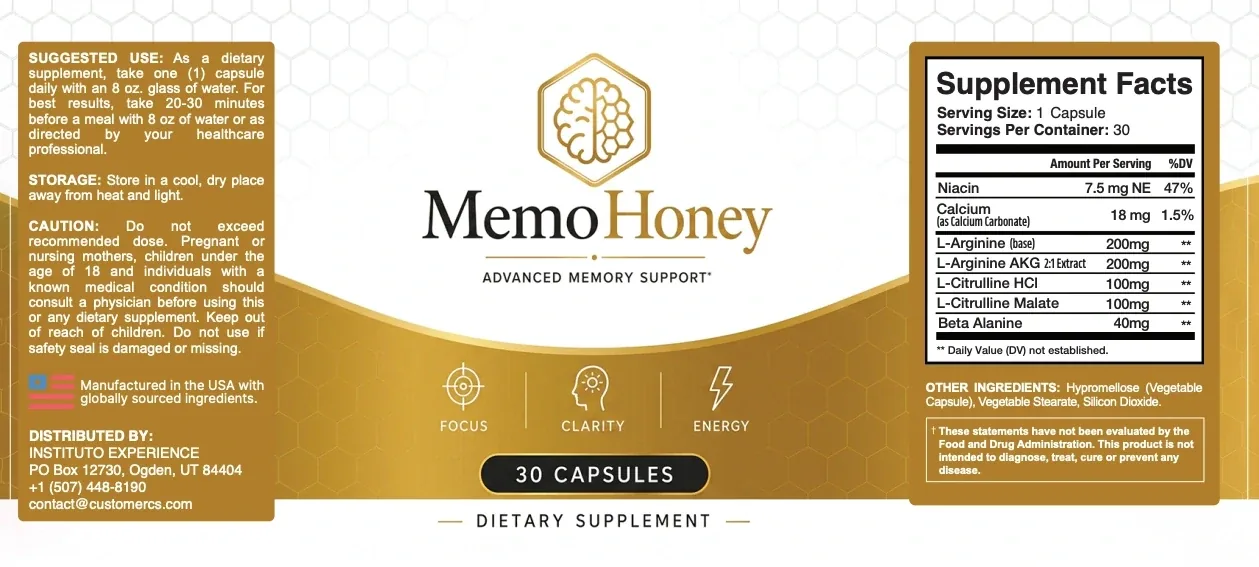
We copy the exact words: MemoHoney, ADVANCED MEMORY SUPPORT*, FOCUS, CLARITY, ENERGY. The asterisk matters, because it points to the FDA statement.
The Supplement Facts box
Serving, servings and all seven lines with amounts and Daily Values, copied as printed.
Other ingredients
Hypromellose, vegetable stearate and silicon dioxide. A sweetener or honey would have to be listed here. None is.
Directions and caution
Dose, timing, storage and who should ask a physician first, word for word.
Who stands behind it
The "Distributed by" line, the phone and the email. A factory name would appear here too; this label prints none.
Why do we keep writing "no honey"?
Because a name is a claim too. The brand calls the capsule MemoHoney, prints it on a honeycomb label, and some ads tell honey stories. Each line below is shown with where it appears and how it checks against the label.
- Not shown
MemoHoney
Brand name and the honeycomb label artNo honey, royal jelly, pollen or other bee product appears anywhere on the panel or in the other ingredients.
- On the label
ADVANCED MEMORY SUPPORT*
Front of the bottleWe quote it as the label's own phrase. It is a structure/function claim, made without FDA review.
- Marketing only
directly targets the real causes of memory loss
mymemohoney.com sales pageNone of the sources we opened links these ingredients, at any dose, to better memory.
- Marketing only
a simple honey-based ritual
Ads described by MalwareTipsAn ad hook, not a product feature. The capsule contains no honey to use in any ritual.
- Not shown
FDA-registered facility
The brand's FAQNo facility is named, and registration is not approval. We report the line and leave it there.
- On the label
Calcium (as calcium carbonate) 18 mg
Label only; left off the brand's ingredient graphicThe label wins, so our pages list seven lines, not six.
In our own words the capsule is "sold for" memory support, and its ingredients were "studied for" blood pressure or exercise. Never "proven", never "boosts".
Which sources can overrule a sales page?
Seven kinds of source feed these pages, each with a fixed job. Select one to see what we take from it and what we refuse to take.
Rank 1 for what is inside
The printed label
Amounts, directions, cautions and the distributor. When another source disagrees about the capsule, the label wins.
Facts about us only
Our seller pack
Our role, office, phone, return address and lot references. Its sample reviews, star score and proposed reviewer are left out because none could be checked.
Prices and policies
Brand pages
mymemohoney.com and the policy pages it links: prices, refund wording and contacts. Health lines from them are quoted as claims.
First stop for health
NIH agencies
The Office of Dietary Supplements, NCCIH and the National Institute on Aging set daily needs and studied doses.
Rules for labels and ads
FDA and FTC
What a supplement may claim, what approval means, and what counts as a misleading memory ad.
Expert guidance
Clinics and charities
Mayo Clinic, Memorial Sloan Kettering, the Linus Pauling Institute, the Alzheimer's Association and an AARP-convened council, each with its date.
Support, with limits
Journals and drug guides
A few trials plus WebMD and RxList. Small samples and company funding are flagged.
How do we compare a label milligram with a study gram?
By adding each amino acid's forms together, then setting the total against the lowest daily dose a source reports. Using the low end gives the product the benefit of the doubt. The FTC asks advertisers to check that their dose and formula match what was studied (FTC, Health Products Compliance Guidance); we run that check for you.
| Label line | In one MemoHoney capsule | Dose in the source | Put simply |
|---|---|---|---|
| Arginine, both forms | below 400 mg | 4 to 24 g daily for blood pressure | less than a tenth of the smallest study dose |
| Citrulline, both salts | below 200 mg | 3 to 9 g daily in trials | about one-fifteenth of the smallest trial dose |
| Beta alanine | 40 mg | 4 to 6 g daily for training | one-hundredth of the low end |
| Niacin | 7.5 mg NE | adult RDA 14 mg (women) to 16 mg (men) | close to half of what adults need each day |
| Calcium | 18 mg | adult RDA 1,000 to 1,200 mg | a tiny slice of daily needs |
Three rules sit behind the table. Salt forms such as AKG, HCl and malate count as a ceiling, since part of their weight is not the amino acid. Niacin and calcium are nutrients, so they are judged against daily needs, not trials. And calcium is quoted at the label's own 1.5% DV, even though the sum comes out slightly lower.
A small dose proves neither safety nor uselessness, so medicine cautions stay in place at any amount. Each ingredient is covered on the MemoHoney ingredients page.
What does "not published" mean here?
It means we looked on the bottle, on every brand page we could open and in our seller pack, and the fact was not there. We mark the gap rather than fill it. Today the gaps are:
- Honey of any kind. The panel and the other ingredients list none.
- The factory. Only a distributor, INSTITUTO EXPERIENCE, is printed.
- A single refund rule with a single return address. Brand pages give several.
- A trial of this formula, or of these amounts, for memory.
- A carrier name and delivery times for shipping.
- A certificate of analysis made public for any batch.
- Customer reviews that we can tie to real orders.
Two codes from our seller pack, lot MEM-26/ME-5252 and certificate MEM-5252-26-ME, let the order desk match a bottle to an order. They are references, not test results, and we never present them as lab proof.
Why are the reviewer and review boxes yellow?
Three things on this site must come from real people, and none has arrived yet. Until it does, each shows as a yellow placeholder, never as a borrowed or invented value.
- The medical reviewer: name, credentials and review date appear only after a licensed clinician has read the pages.
- Customer reviews: a card is filled only once the order desk has matched its writer to a real order.
- The rating: worked out from matched reviews alone, never copied from a seller document or a sales page.
Sample reviews, a star score and order totals came with our seller pack. None of it appears here in any form, because none of it could be checked. The empty cards wait on the MemoHoney reviews page.
Affiliate disclosure: do order buttons change what we write?
Memohoneycare earns money on orders placed through the buttons on this site, and each of those links carries a sponsored tag in the HTML. The price at checkout is the same as going to the brand directly.
Money from orders could tempt any seller to soften bad news, so these rules are fixed:
- Order buttons state only what the brand prints: 60 days to ask for a refund, no shipping charge in the US on 3 or 6 bottles, one payment and no plan.
- No ticking clocks or low-stock alerts; the FTC names these as tricks used on shoppers (FTC, Report on dark patterns (press release)).
- Crossed-out prices are called a reference price, never a saving.
- The dose gap and the missing memory evidence stay in view on every page where they apply.
Who we are and how the business works is on the about Memohoneycare page.
How do I report an error, and what has changed so far?
Write to [email protected] and paste the line you think is wrong, plus the page it is on. The inbox is read Mon-Fri 9:00 am-5:00 pm ET. We check the line against its source and, if it is wrong, fix it and log the change below.
| When | What we did | Note |
|---|---|---|
| October 11 to 13, 2026 | Health, regulator and legal sources opened and summarized | Pages that would not load were listed as failures and never quoted. |
| October 13, 2026 | Label copied; brand home, FAQ, bonus, variant, upsell and policy pages read | Prices, refund wording and contacts on this site start from these readings. |
| October 13, 2026 | Site first published | Every page dated, with the reviewer slot still open. |
| At each update | Prices, refund rules and contact lines compared with the live brand pages | Any change gets its own line here. |
Questions about our methods
Why does every Memohoneycare page repeat that MemoHoney has no honey?
Because it is the question people ask most, and the name points the wrong way. The label lists no honey or bee product, so we say it plainly wherever the topic comes up.
If the MemoHoney website and the bottle disagree, which do you follow?
The bottle. The website's ingredient graphic leaves out calcium and spells niacin in Portuguese once; the printed label has all seven lines.
Why write "under 400 mg" of arginine rather than an exact figure?
Part of the arginine AKG line is alpha-ketoglutarate, and no source we found gives the exact split. An upper limit is honest; a made-up decimal is not.
Do Trustpilot or Reddit posts count as evidence?
No. A small third-party review page is described, as unverified, on our reviews and legitimacy pages. It never supports a health statement.
Can the brand pay to change what a page says?
No. The brand has not seen these pages, and no company can buy a sentence, a ranking or a rating here.
What happens after I report a mistake?
We check the line against its source. If we got it wrong, the page is fixed and the update log gets a dated entry, without your name.
Why cite a brain health report from 2019?
It is still the clearest expert statement on supplements and cognitive decline that we could open. We print its year so you can weigh it.
Page check
Written by
Reads the MemoHoney label line by line and weighs each health statement against NIH, Mayo Clinic and Alzheimer's Association guidance.
- Label re-read on October 13, 2026
- Product details: the printed label and brand pages. Health details: the sources linked in the text
- Found an error? Write to [email protected]. How we work: editorial standards