How Does MemoHoney Work? The Brand's Idea, Explained Simply
Quick answer
The brand says MemoHoney's nutrients raise blood flow to the brain and help fuel brain cells.
The capsule holds arginine, citrulline, beta alanine, niacin and calcium, and no honey. Food, activity and sleep also matter a lot for memory.
Next, see what the label promises.

How does MemoHoney say it works, in plain words?
The brand tells a short story. MemoHoney, its website says, holds "carefully selected nutrients found in nature" that "work in synergy". Each one was chosen to "increase cerebral blood flow" and "deliver energy to neurons". The mix, it says, "directly targets the real causes of memory loss".
Retold for a kitchen table: you swallow a capsule, more blood reaches your brain, brain cells get more fuel, and your memory works better. Each step sounds reasonable. The trouble is that nobody has tested the steps for this capsule, and the sources we read do not support the last two.
Below we take the story apart one piece at a time, using government health agencies, Mayo Clinic and the Alzheimer's Association. Nothing here comes from the sales page except the quotes.
Where does honey fit into the MemoHoney story?
Nowhere. The brand's own pages never say honey helps memory, and the bottle lists no honey. The honey lives in the name, the gold color and the honeycomb drawn around a brain on the logo.
Some ads tell a different tale. A security site, MalwareTips, describes ads that open with a "simple honey-based ritual" and celebrity-style videos before sending viewers to a MemoHoney order page. The capsule in the bottle has nothing to do with that ritual. No celebrity endorsement of the product is on record.
The full story of the name, and the fake ads that borrow it, is on is there honey in MemoHoney.
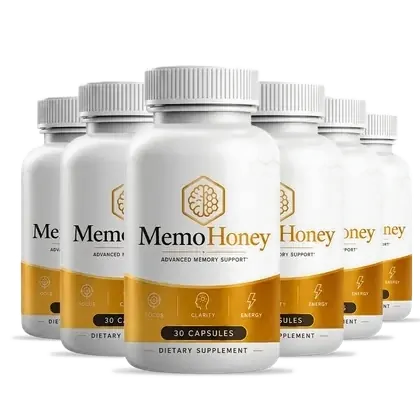
The 6-bottle box is the cheapest way to buy MemoHoney.
$49 per bottle with the 6-bottle box, $294. Refunds within 60 days · 3 or 6 ship free · BuyGoods secure payment.
What is each ingredient supposed to do, and what do sources say?
Tap an ingredient around the bottle. Each panel puts the brand's one-line promise beside what we could confirm in health references.
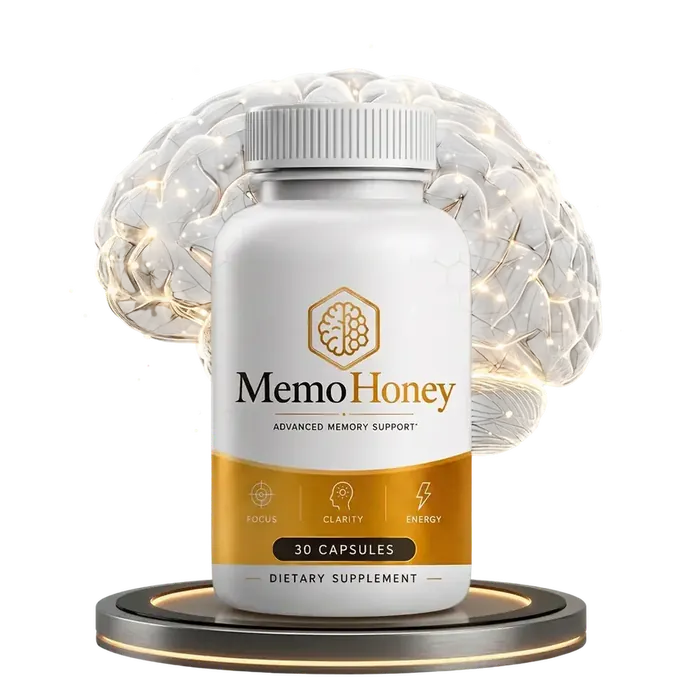
Label: 200 mg
L-arginine
The brand calls it an amino acid the body converts "directly into nitric oxide", a gas that relaxes blood vessels. Only "some" arginine takes that route (NIH ODS, Dietary Supplements for Exercise and Athletic Performance (health professional)). No source we read ties it to memory.
Studied at: 4 to 24 g a day for blood pressure
Label: 200 mg
Arginine AKG 2:1
Said to be "an advanced form" that "improves absorption". We found no health agency page on this form at all, so the absorption claim cannot be checked.
Studied at: No trial results we could open
Label: 100 mg HCl + 100 mg malate
L-citrulline
Described as recycled into arginine "in a continuous cycle". About 80% of citrulline does become arginine in the kidneys (NIH ODS, Dietary Supplements for Exercise and Athletic Performance (health professional)). "Continuous cycle" is sales wording, not a measurement.
Studied at: 3 to 9 g a day in blood pressure trials
Label: 40 mg
Beta alanine
Said to raise carnosine "in the brain" and protect neurons. Studies show it raises carnosine in muscle at 4 to 6 g a day (ISSN position stand: Beta-Alanine (2015)).
Studied at: 2.4 g a day in the one older-adult thinking trial
Label: 7.5 mg NE
Niacin
The website (under the Portuguese heading "Niacina") says it powers "the energy machinery inside every neuron". The NIH fact sheet mentions memory only as a sign of severe niacin shortage.
Studied at: Adults need 14 to 16 mg NE a day
Label: 18 mg
Calcium
The brand's story skips it entirely, though the bottle lists it. No source we read links calcium to memory.
Studied at: Adults over 50 need 1,000 to 1,200 mg a day
Why does the MemoHoney photo show blueberries and leaves that are not inside?
Because they look like brain food. The brand's product photo places the bottle among fresh blueberries, sprigs of rosemary and thyme, mint, fan-shaped leaves that resemble ginkgo, and two white shaggy rounds. None of them is on the label.
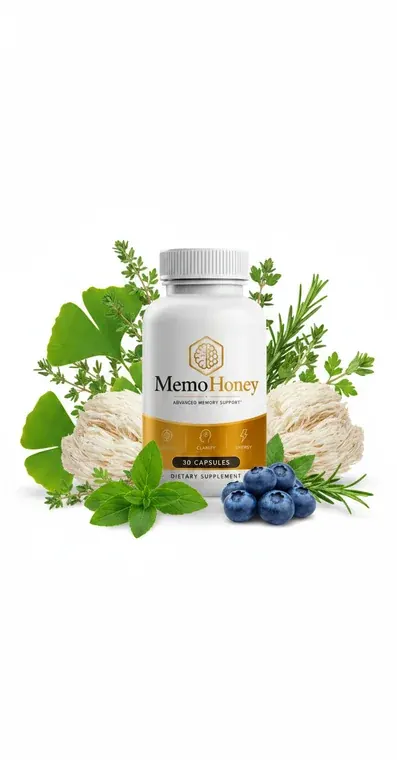
The leaves are worth a second look. Ginkgo is the best-known memory herb, and in a large NIH-sponsored trial it was no better than a placebo at preventing or delaying Alzheimer's (Alzheimer's Association, Alternative Treatments). MemoHoney does not contain it anyway.
The fruit points somewhere more useful. Mayo Clinic's memory advice includes a diet of fruits, vegetables and whole grains (Mayo Clinic, Memory loss: 7 tips to improve your memory), and an AARP expert panel says to get nutrients from food rather than pills (Global Council on Brain Health (AARP), The Real Deal on Brain Health Supplements).
So the photo is right about the plate and silent about the capsule. Our food-first memory guide turns that plate into everyday meals.
How close is the MemoHoney story to proof?
Not close. A memory claim would need a few things in place, and none of them is.
| What the story would need | What we found | Source |
|---|---|---|
| A trial of the finished capsule | None. The site's "Scientific References" is a strip of logos with no study named | Brand site |
| An ingredient shown to help memory in healthy adults | None. Arginine for age-related memory loss is rated "Insufficient Evidence to Rate" | (RxList, L-Arginine (supplement monograph)) |
| Doses close to those studied | Under 400 mg of arginine, against 4 to 24 g a day for blood pressure | (RxList, L-Arginine (supplement monograph)) |
| A thinking benefit from beta alanine | No overall difference at 2.4 g a day; only a subgroup improved | (Nutrients 2023, Ostfeld et al., beta-alanine and cognition in older adults) |
| Support from memory experts | No supplement is recommended for brain health | (Global Council on Brain Health (AARP), The Real Deal on Brain Health Supplements) |
One more point for fairness: the beta alanine trial was paid for by a company, and only people with lower starting scores improved. Our sources do not let anyone stretch that result to a 40 mg capsule.
Why does a memory capsule contain sports-nutrition ingredients?
The brand does not say. Arginine, citrulline and beta alanine are mostly studied for blood pressure, heart symptoms and exercise, almost always in grams (NIH ODS, Dietary Supplements for Exercise and Athletic Performance (health professional)). Memory was not what those studies measured.
A clue sits on the MemoHoney home page itself. One heading reads "See how MemoHoney is helping men regain their freedom, confidence and vitality", wording that fits a men's product far better than a memory capsule. It looks like copy carried over from another sales page.
That matters for older buyers, because arginine can lower blood pressure (Mayo Clinic, L-arginine). On blood pressure or heart pills? Talk to your doctor first. Every line of the formula is broken down on the ingredients page.
What does support memory after 50, according to health sources?
Ordinary habits, done most days. Mayo Clinic lists seven: staying physically active, keeping the mind busy, spending time with people, staying organized, sleeping well, eating fruits, vegetables and whole grains, and managing health conditions with your care team (Mayo Clinic, Memory loss: 7 tips to improve your memory).
Some memory trouble has a fixable cause. The National Institute on Aging names medicine side effects, low vitamin B12, too much alcohol, and thyroid, kidney or liver problems (NIA, Forgetfulness: Knowing When to Ask for Help). A doctor can test for these; a capsule cannot.
MemoHoney science questions, answered simply
What does MemoHoney actually do in the body?
Nobody has measured it. The capsule supplies small amounts of amino acids, niacin and calcium, and no study shows these amounts change memory.
Where does the name MemoHoney come from, with no honey in it?
The brand does not explain the name. Honey appears only in the name and design, not in the formula or the brand's own claims.
Does MemoHoney contain ginkgo or blueberry extract?
No. They appear in the brand photo as props, but the label lists only amino acids, niacin and calcium.
Can MemoHoney give brain cells more energy?
No source we read shows that. The niacin is about half a day's need, and the NIH links niacin to memory only in severe deficiency.
Is MemoHoney a nootropic?
It is sold as a dietary supplement for memory support. No study shows that it changes thinking, which is what the word nootropic implies.
What is the "neuroactive combination" in MemoHoney?
It is the brand's name for the six ingredients its website lists. No study of that combination was found.
Is MemoHoney like Prevagen?
No, the ingredients differ. The FTC sued Prevagen's makers over memory claims; that case did not involve MemoHoney, but it shows memory claims need real evidence.
Can MemoHoney reverse memory loss?
No. Not a single supplement has been proven to prevent, treat or cure Alzheimer's, and memory loss needs a doctor's check.
Page check
Written by
Reads the MemoHoney label line by line and weighs each health statement against NIH, Mayo Clinic and Alzheimer's Association guidance.
- Label re-read on October 13, 2026
- Product details: the printed label and brand pages. Health details: the sources linked in the text
- Found an error? Write to [email protected]. How we work: editorial standards