MemoHoney Ingredients: The Seven Lines in One Capsule
Quick answer
One MemoHoney capsule lists seven ingredients, and despite the name, none of them is honey.
Arginine comes in two forms (200 mg base and 200 mg AKG 2:1), citrulline in two salts (100 mg each), plus 40 mg beta alanine, 7.5 mg NE niacin and 18 mg calcium.
You can read the label in large print.
Does MemoHoney have honey in it? No: here is what is actually inside
There is no honey in MemoHoney: not a drop, not a powder, not an extract. The word lives only in the brand name and the honeycomb artwork.
What it does hold: amino acids, one B vitamin and a pinch of a mineral.
- Arginine, twice: 200 mg as plain L-arginine (base) and 200 mg as L-arginine AKG 2:1 extract
- Citrulline, twice: an HCl salt and a malate salt, 100 mg of each
- 40 mg of beta alanine, with no Daily Value set
- Niacin (vitamin B3) at 7.5 mg NE, printed as 47% of the Daily Value
- Calcium carbonate supplying 18 mg of calcium (1.5% DV on the panel)
One capsule a day is the full dose. No secret blend, no sweetener, no bee product. If a video about a morning honey ritual brought you here, our page on the honey name explains where that story comes from.
Why does the MemoHoney website show only six ingredients?
Because calcium is missing from it. The brand's sales page and its "Inside MemoHoney" graphic both name six ingredients; the bottle names seven.
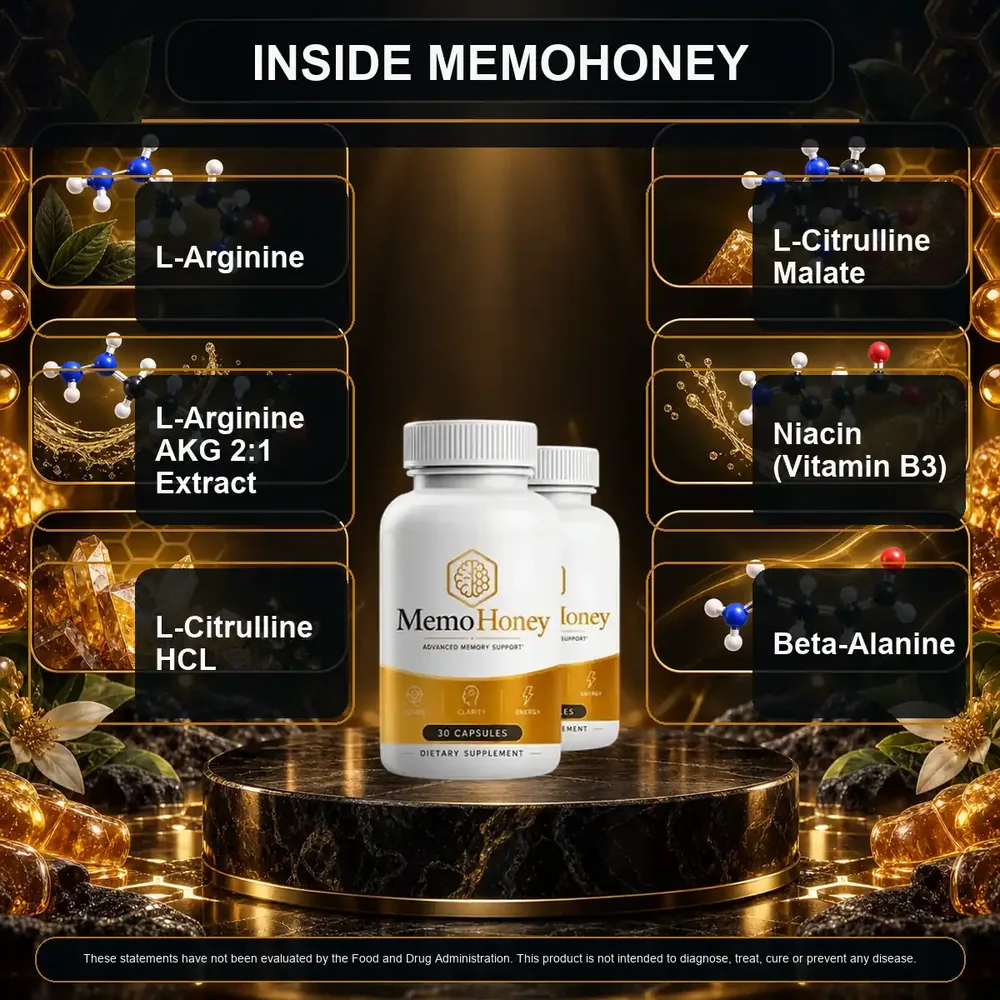
- Calcium is left out. The 18 mg on the label appears nowhere on the sales page or in the graphic.
- "Niacina". One heading on the brand page uses the Portuguese spelling. It is still vitamin B3.
- No milligrams. Only the bottle gives amounts, so we follow the bottle.
The 6-bottle box is the cheapest way to buy MemoHoney.
$49 per bottle with the 6-bottle box, $294. Refunds within 60 days · 3 or 6 ship free · BuyGoods secure payment.
What do the chemical names on the label mean in plain English?
Tap a name to see what it means and what it gets confused with.
Amino acid, 200 mg (base)
L-arginine
A protein building block the body also makes itself. As a supplement it is studied by the gram, and medical pages flag it with heart and blood pressure medicines (Mayo Clinic, L-arginine).
Read the L-arginine pageBound form, 200 mg
Arginine AKG
Arginine joined to alpha-ketoglutarate in one compound. It is not a separate AKG supplement and not creatine AKG. The 200 mg weighs both parts together.
Read the Arginine AKG pageAmino acid, 100 mg + 100 mg
L-citrulline
Nothing to do with citrus fruit. The kidneys turn about 80% of the body's citrulline into arginine (NIH ODS, Dietary Supplements for Exercise and Athletic Performance (health professional)). HCl and malate are two salts of one molecule.
Read the L-citrulline pageAmino acid, 40 mg
Beta alanine
Not plain alanine and not alpha-lipoic acid. Athletes take grams of it to raise carnosine in muscle (ISSN position stand: Beta-Alanine (2015)).
Read the Beta alanine pageVitamin B3, 7.5 mg NE
Niacin
A B vitamin, not nicotine. The label does not say which form is used: nicotinic acid or niacinamide.
Read the Niacin pageMineral, 18 mg
Calcium
Calcium carbonate, the compound also sold in antacids such as Tums (NIH ODS, Calcium (consumer)). The brand's own lists skip it.
Read the Calcium pageDoes 400 mg of arginine lines mean 400 mg of arginine?
No, a little less. Three of the four amino acid lines are weighed together with a partner molecule, so the printed number is bigger than the amino acid inside.
- L-arginine (base), 200 mg
- All arginine. The only line with no partner.
- L-arginine AKG 2:1, 200 mg
- Shared with alpha-ketoglutarate: under 200 mg of arginine.
- L-citrulline malate, 100 mg
- Malic acid rides along, so citrulline from it is less than 100 mg.
- L-citrulline HCl, 100 mg
- Hydrochloride rides along; again, less than 100 mg of citrulline.
So a capsule gives under 400 mg of arginine and under 200 mg of citrulline. No source gives the exact split, so we do not guess one.
What is each ingredient studied for, and what should someone over 50 watch?
One row per ingredient: its plain job, the research, the shortfall, and the caution most likely to matter if you are past 50 and on daily medicines.
| On the label | What it is | Studied for | Dose gap | One caution |
|---|---|---|---|---|
| L-arginine, 200 mg | Amino acid | High blood pressure, chest pain, erectile problems (RxList, L-Arginine (supplement monograph)) | Blood pressure studies used 4 to 24 g a day | Not recommended after a recent heart attack (Mayo Clinic, L-arginine) |
| Arginine AKG 2:1, 200 mg | Arginine plus alpha-ketoglutarate | No medical reference page covers this form | Counts toward the under-400 mg arginine total | Treat it like arginine with nitrates or sildenafil-type pills |
| Citrulline HCl and malate, 100 mg each | Amino acid in two salts | Blood pressure: systolic about 4 mm Hg lower in pooled trials (Avicenna J Phytomed 2019, Barkhidarian et al., L-citrulline and blood pressure meta-analysis) | Those trials gave 3 to 9 g a day | Avoid with nitrates; with ED drugs, pressure may drop too far (WebMD, L-citrulline: Uses and Risks) |
| Beta alanine, 40 mg | Amino acid | Short, intense exercise; one trial in older adults at 2.4 g found no overall difference from placebo in thinking scores (Nutrients 2023, Ostfeld et al., beta-alanine and cognition in older adults) | About 1% of the 4 g sports dose | Tingling starts near 800 mg, so it is unlikely here (ISSN position stand: Beta-Alanine (2015)) |
| Niacin, 7.5 mg NE | Vitamin B3 | Preventing deficiency; the NIH sheet ties memory only to deficiency (pellagra) (NIH ODS, Niacin (health professional)) | None: about half of the 14 to 16 mg adults need | Flushing begins around 30 to 50 mg of nicotinic acid, far above this |
| Calcium, 18 mg | Mineral (carbonate) | Daily mineral needs, not memory | Target after 50: 1,000 to 1,200 mg daily | Spacing it from thyroid pills (see below) |
The third column never says memory, focus or clarity. No source showed any of these helps them, at any dose.
Are the MemoHoney amounts anywhere near what research used?
Only for niacin. Each bar is the label amount as a share of the smallest studied dose, drawn to scale. Most are barely visible.
In the capsule: below 400 mg. In research: 4 to 24 g daily for blood pressure. (RxList, L-Arginine (supplement monograph)) (Memorial Sloan Kettering, Arginine (About Herbs))
In the capsule: below 200 mg. In research: 3 to 9 g daily in trials. (Avicenna J Phytomed 2019, Barkhidarian et al., L-citrulline and blood pressure meta-analysis) (NIH ODS, Dietary Supplements for Exercise and Athletic Performance (health professional))
In the capsule: 40 mg. In research: 4 to 6 g daily for training. (ISSN position stand: Beta-Alanine (2015)) (NIH ODS, Dietary Supplements for Exercise and Athletic Performance (health professional))
In the capsule: 7.5 mg NE. In research: adult RDA 14 mg (women) to 16 mg (men). (NIH ODS, Niacin (health professional))
In the capsule: 18 mg. In research: adult RDA 1,000 to 1,200 mg. (NIH ODS, Calcium (health professional))
Small amounts do not erase the medicine questions, because the sources set no safe floor. And the Alzheimer's Association says not one supplement has been proven to prevent, treat or cure Alzheimer's (Alzheimer's Association, Alternative Treatments).
Is the 18 mg of calcium in MemoHoney worth counting?
For your daily total, hardly. Women over 50 and everyone over 70 are advised to get 1,200 mg a day, and men aged 51 to 70 1,000 mg (NIH ODS, Calcium (consumer)). One capsule covers about 1.5% to 1.8% of that.
On the panel the line reads 1.5% DV, measured against a 1,300 mg Daily Value (NIH ODS, Calcium (health professional)). Why so little was added, the bottle does not say.
- Timing. Calcium carbonate is absorbed best with food, while the label says to take the capsule 20 to 30 minutes before a meal. At 18 mg it hardly matters.
- Thyroid pills. Levothyroxine absorption drops if it and calcium carbonate are taken less than 4 hours apart (NIH ODS, Calcium (consumer)). No source sets a cut-off for so small an amount, so ask your pharmacist how to space the two.
What are the other ingredients in a MemoHoney capsule?
Three inactive items, listed without amounts. They form the shell and help the powder fill it.
| Other ingredient | Its job |
|---|---|
| Hypromellose | Forms the shell; the label calls this a vegetable capsule |
| Vegetable stearate | Keeps powder from sticking to machines |
| Silicon dioxide | Stops the fill from clumping |
Not on the list: honey, sugar, gelatin, caffeine or any sweetener.
Questions about MemoHoney ingredients
What are the ingredients in MemoHoney?
Arginine (200 mg base, 200 mg AKG 2:1), citrulline (100 mg HCl, 100 mg malate), 40 mg of beta alanine, 7.5 mg NE of niacin and 18 mg of calcium, in a plant-cellulose shell.
Is there any honey in MemoHoney?
No. Honey appears only in the name and the label art; the panel lists no honey, sugar or bee product.
Is there a MemoHoney recipe I mix with honey?
No. It is a capsule taken once a day with water. A lovable.app page describes a honey and royal jelly formula that does not match the real label.
Can niacin help memory?
The NIH fact sheets mention memory only as a symptom of severe deficiency (pellagra). The 7.5 mg here is an ordinary nutrient amount.
Does citrulline help brain fog?
No source we read tested it for that. Citrulline trials looked at blood pressure and exercise, at 3 to 9 g a day.
Why does the MemoHoney site spell it "Niacina"?
It is the Portuguese spelling, likely left from a site built partly in Portuguese. The bottle says niacin.
Is 18 mg of calcium a meaningful amount?
Not for daily needs. The target after 50 sits between 1,000 and 1,200 mg, so one capsule covers less than 2%.
Page check
Written by
Reads the MemoHoney label line by line and weighs each health statement against NIH, Mayo Clinic and Alzheimer's Association guidance.
- Label re-read on October 13, 2026
- Product details: the printed label and brand pages. Health details: the sources linked in the text
- Found an error? Write to [email protected]. How we work: editorial standards