Beta-Alanine in MemoHoney: What the Older-Adult Trial Really Found
Quick answer
Each MemoHoney capsule lists 40 mg of beta-alanine. The only older-adult trial used 2.4 g daily, 60 times more, for 10 weeks and found no overall difference in thinking scores; a subgroup with lower scores improved, and a company paid for it. Skin tingling is linked to about 800 mg or more, 20 capsules' worth.
Why does a memory capsule contain beta-alanine, a sports ingredient?
Beta-alanine is an amino acid that is sold mostly to athletes. The body uses it to build carnosine in muscle, which is why sports products carry it (ISSN position stand: Beta-Alanine (2015)).
In MemoHoney it is the smallest line in the Supplement Facts box: 40 mg, with no Daily Value set. The brand's sales page says it raises carnosine in the brain to guard neurons. The research we read measured muscle, not the brain, so we treat that line as a sales claim.
Two quick clarifications for older readers. Beta-alanine is a different compound from plain L-alanine and from alpha-lipoic acid (ALA). And it has no link to bees: the MemoHoney label lists no honey at all.
What did the 10-week beta-alanine trial in older adults show?
No, not across the whole group. A 2023 study gave 100 adults, average age 70.6, either 2.4 g of beta-alanine or a dummy pill daily for 10 weeks. At the end, overall thinking scores were level between the two groups (Nutrients 2023, Ostfeld et al., beta-alanine and cognition in older adults). Select each part of the study:

100 older adults
Who took part
Volunteers with an average age of 70.6 were randomly split into a beta-alanine group and a placebo group. The study was double-blind, so neither side knew who got which.
2.4 g a day for 10 weeks
The dose
That is 2,400 mg a day, sixty times the 40 mg in one MemoHoney capsule.
No overall difference
Main result
MoCA scores, the trial's measure of thinking, ended up the same in both groups when everyone was counted.
Lower starting scores only
Subgroup
People who began with a MoCA of 26 or lower did better on beta-alanine: 13.6% at the halfway point and 11.8% at week 10, compared with placebo.
Mostly no change
Mood and body
No differences in mood, anxiety or physical performance. Depression scores did fall in the beta-alanine group.
Industry funding
Who paid
The research portal lists Natural Alternative Inc., a company, as the funder.
Three things limit what this tells you. The gain showed up only in one slice of the group, a supplement company paid for the work, and nobody has tested 40 mg. FTC guidance says health claims need solid evidence that matches the dose and formula actually sold (FTC, Health Products Compliance Guidance).
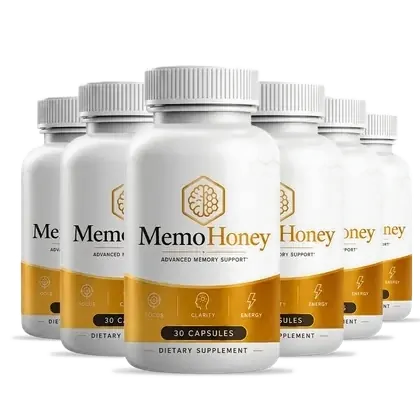
The 6-bottle box is the cheapest way to buy MemoHoney.
$49 per bottle with the 6-bottle box, $294. Refunds within 60 days · 3 or 6 ship free · BuyGoods secure payment.
Milligrams vs grams: how far is 40 mg from the studied doses?
It is a tiny fraction. One capsule holds 40 milligrams; the older-adult trial used 2.4 grams, which is 2,400 milligrams, or 60 times more.
Milligrams and grams are easy to mix up on a small label. A gram is 1,000 milligrams. This table turns each research amount into MemoHoney capsules, so the gap is plain without a calculator:
| Where the amount comes from | Beta-alanine | In milligrams | MemoHoney capsules |
|---|---|---|---|
| One MemoHoney capsule | 40 mg | 40 | 1 |
| A whole 30-capsule bottle | 1.2 g | 1,200 | 30 |
| Point where tingling tends to start | about 800 mg | 800 | 20 |
| Split dose used to ease tingling | 1.6 g | 1,600 | 40 |
| Older-adult trial, each day for 10 weeks | 2.4 g | 2,400 | 60, two bottles a day |
| Sports dose, at least 2 to 4 weeks | 4 to 6 g a day | 4,000 to 6,000 | 100 to 150 |
| NIH safety data, up to 8 weeks | 1.6 to 6.4 g a day | 1,600 to 6,400 | 40 to 160 |
The label says not to go past one capsule a day. So every finding in this table, helpful or not, comes from amounts MemoHoney cannot supply as directed. The full panel is set out on our supplement facts page.
Where is beta-alanine on the MemoHoney label?
At the very bottom of the Supplement Facts box, under the two citrulline salts. Tap the numbers to read what each part of the label tells you about it:
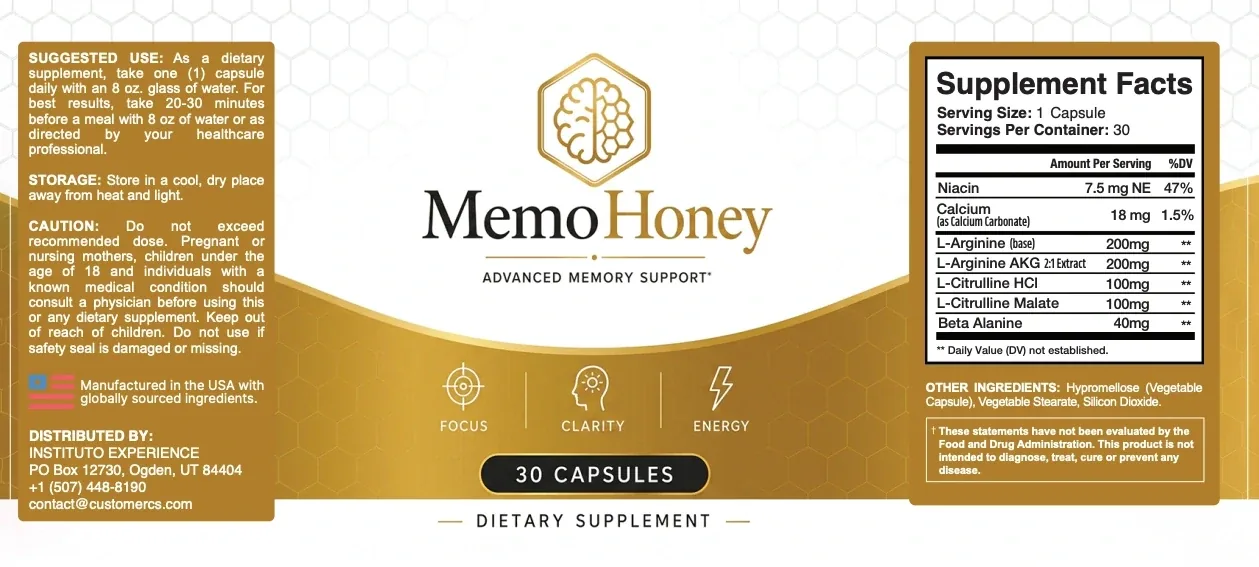
- Beta Alanine, 40mg. The last ingredient line. Printed without a percentage because no daily need exists.
- Daily Value not established. The double star note. It covers all five amino acid lines, beta-alanine included.
- Serving size, 1 capsule. Thirty servings per bottle, so 1.2 g of beta-alanine in the whole bottle.
- The name. Honeycomb art and the word Honey, yet no honey appears anywhere in the ingredient list.
- Suggested use. One capsule daily with 8 oz of water, 20 to 30 minutes before a meal.
- Caution. Pregnant or nursing mothers, under-18s and anyone with a known medical condition should ask a physician first.
The brand's Inside MemoHoney graphic and sales page name beta-alanine as well, so on this line every source agrees. How it sits beside the other five ingredients is on our MemoHoney ingredients page.
Beta-alanine tingling: why 40 mg is unlikely to cause it
It is very unlikely. The pins-and-needles feeling, called paresthesia, is reported from about 800 mg, or more than 10 mg for each kilogram a person weighs (NIH ODS, Dietary Supplements for Exercise and Athletic Performance (health professional)). That is 20 capsules' worth.
At big sports doses it tends to affect the face, the neck, the upper trunk and the backs of the hands, then fades within 60 to 90 minutes. WebMD says it is not harmful and goes away by itself (WebMD, Beta-Alanine).
For older readers the useful point runs the other way. If you notice new tingling or numbness after starting any product, 40 mg of beta-alanine is an unlikely cause, so stop the product and tell your doctor.
Beta-alanine side effects and safety questions for older adults
At sports doses it looks safe for healthy people in the short run, but there are gaps. The sports nutrition society notes there are no safety data beyond one year (ISSN position stand: Beta-Alanine (2015)). WebMD adds that beta-alanine has never gone through an FDA review for safety or effectiveness.
- Prescription medicines: WebMD says beta-alanine's interactions are not fully understood (WebMD, Beta-Alanine). In MemoHoney, the arginine and citrulline raise the larger questions, with blood pressure, nitrate and ED drugs.
- Pregnancy, nursing or under 18: the effects of beta-alanine are unknown, and the label asks these groups to see a physician first.
- Allergies: WebMD lists serious allergic reactions as possible with beta-alanine.
The medicine cautions for the whole capsule are on our side effects page. If memory is what worries you, our memory after 50 guide covers the signs worth a doctor's visit.
Beta-alanine questions for adults over 50
Is beta-alanine good for memory in seniors?
The one trial we found in older adults says not for the group as a whole. At 2.4 g a day for 10 weeks, overall thinking scores matched placebo; only people who started with lower scores improved.
Who paid for the beta-alanine study in older adults?
A company. The university research portal lists Natural Alternative Inc. as the funder, not a public body such as the NIH, so the result deserves an independent repeat.
How many MemoHoney capsules would match the trial dose?
Sixty a day. The trial used 2.4 g, and each capsule holds 40 mg, so you would need two full bottles every day. The label allows one capsule.
Will MemoHoney make my face or hands tingle?
Very unlikely from the beta-alanine. Tingling is reported at about 800 mg or more, which is 20 capsules' worth, so tell your doctor about new tingling rather than blaming 40 mg.
Did beta-alanine help older adults stay strong or steady?
Not in that trial. Physical performance tests showed no difference between the beta-alanine and placebo groups after 10 weeks.
Did the trial find any change in mood?
Mood and anxiety did not differ between groups, while depression scores fell on beta-alanine. It is one company-funded study at 60 times the capsule amount, so it says nothing about 40 mg.
Is beta-alanine safe with my prescriptions?
Nobody can say for sure. WebMD notes that its interactions with medicines are not fully understood, so bring the label to your pharmacist, especially since the same capsule also contains arginine.
Why do sports supplements use so much more beta-alanine?
Raising muscle carnosine takes 4 to 6 g a day for at least 2 to 4 weeks, according to the sports nutrition society's position stand. Smaller amounts were not shown to do it.
Page check
Written by
Reads the MemoHoney label line by line and weighs each health statement against NIH, Mayo Clinic and Alzheimer's Association guidance.
- Label re-read on October 13, 2026
- Product details: the printed label and brand pages. Health details: the sources linked in the text
- Found an error? Write to [email protected]. How we work: editorial standards