MemoHoney Research: Which Studies Exist, at What Dose, and What They Did Not Test
Quick answer
There is no published research on the finished MemoHoney capsule. Its ingredients were studied for blood pressure, exercise and nutrient needs, in grams rather than milligrams, and none tested memory in healthy adults. The one older-adult thinking trial used 60 times the beta alanine in a capsule and found no overall difference.
Has MemoHoney itself been studied?
We could not find a study of the finished capsule, in any journal or on any brand page. The brand's home page shows a picture titled Scientific References. It holds logos from journals and news outlets, but it names no study, no author and no year.
That matters, because a claim about a product needs evidence about that product, at that dose. The FTC's health claims guidance says as much: evidence has to match the formula and the amounts actually sold (FTC, Health Products Compliance Guidance). A study of a different dose, or of one ingredient on its own, does not stand in for it.
Key facts
- No study of the finished MemoHoney capsule exists. The Scientific References image on the brand's home page shows logos, with no study, author or year.
- Arginine: under 400 mg in a capsule, against 4 to 24 g a day in blood pressure studies.
- Citrulline: under 200 mg in a capsule, against 3 to 9 g a day in blood pressure trials.
- Beta alanine: 40 mg in a capsule, against 4 to 6 g a day for training and 2.4 g in the one older-adult thinking trial.
- Niacin 7.5 mg NE and calcium 18 mg are nutrient amounts, not research doses for memory.
- No expert group we use recommends any supplement for brain health, apart from correcting a proven deficiency.
- Not published: any study of this formula, and the brand's basis for its memory claims.
What research exists for each ingredient?
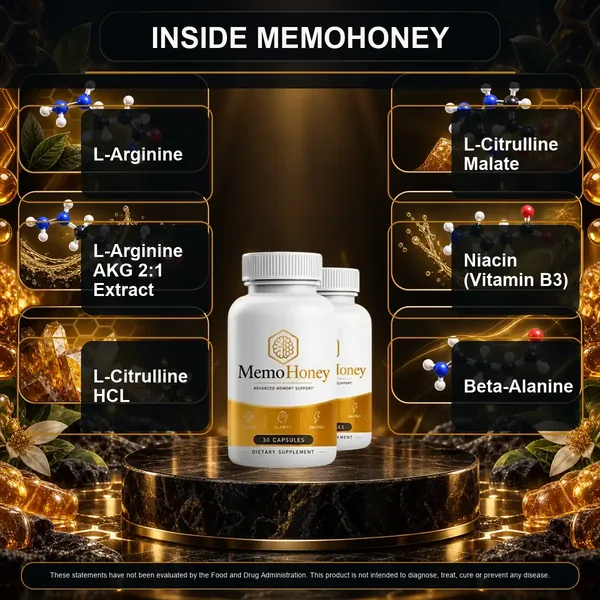
Some. But it is mostly about other things, and it uses far bigger amounts. Here is each ingredient, set beside what was studied.
| Ingredient | In one capsule | Studied for, and at what dose | Tested for memory? |
|---|---|---|---|
| L-arginine (two label lines) | Under 400 mg in all | Blood pressure at 4 to 24 g a day; exercise at 2 to 20 g | No. RxList rates age-related memory loss as Insufficient Evidence to Rate (RxList, L-Arginine) |
| L-citrulline (HCl and malate) | Under 200 mg of citrulline | Blood pressure trials at 3 to 9 g a day (Avicenna J Phytomed 2019, Barkhidarian et al.) | No source we read tested it |
| Beta alanine | 40 mg | Training at 4 to 6 g a day (ISSN position stand: Beta-Alanine (2015)); one older-adult thinking trial at 2.4 g | One trial: no overall difference |
| Niacin | 7.5 mg NE | Adult needs of 14 mg NE (women) and 16 mg NE (men) (NIH ODS, Niacin (health professional)) | Memory loss appears only as a sign of severe shortage |
| Calcium | 18 mg | Adult needs of 1,000 to 1,200 mg a day (NIH ODS, Calcium (health professional)) | No source links it to memory |
One more line needs a note. L-arginine AKG 2:1, 200 mg, is arginine paired with alpha-ketoglutarate. No medical reference page we read covers that form, so its absorption claim cannot be checked. We count it toward the arginine total.
No study backs the capsule, so any test is a personal one. The brand's order page shows the packs and the 60-day refund terms for it.
We earn a commission when you order through our buttons, at no extra cost to you.
What did the one older-adult thinking trial find?
It involved beta alanine, the smallest line on the label. In 2023, researchers gave 100 adults, average age 70.6, either 2.4 g of beta alanine or a dummy pill every day for 10 weeks (Nutrients 2023, Ostfeld et al.).
- Overall result: thinking scores, measured with the MoCA test, ended level between the two groups.
- A subgroup: people who began with a MoCA score of 26 or lower did better on beta alanine than on the dummy pill.
- Other measures: mood, anxiety and physical performance showed no differences, although depression scores did drop in the beta alanine group.
- Who paid: a company, Natural Alternative Inc., is listed as the funder.
- The dose: 2,400 mg a day, which is 60 times the 40 mg in one MemoHoney capsule.
So the trial found no overall thinking benefit, and nobody has tested 40 mg. It cannot be stretched to this capsule.
Is MemoHoney a nootropic?
It is marketed as a dietary supplement for memory support. The word nootropic implies a substance that changes thinking, and nothing shows that MemoHoney does. So searches such as memohoney nootropic and nootropic for memory lead back to the same gap: no study.
How does MemoHoney say it works? The brand's story is that its nutrients raise blood flow to the brain and deliver energy to neurons. No study of the capsule backs either step, and none of the sources we use links these amounts to better memory.
The brand's website calls its six listed ingredients a neuroactive combination that works in synergy. We found no study of that combination. The label itself is more modest. It says ADVANCED MEMORY SUPPORT with an asterisk that points to the FDA notice, and the notice adds that the product is not meant to diagnose, treat, cure or prevent disease.
As for the best nootropic for memory, the expert groups below name none.
What do expert groups say about memory supplements?
They are cautious, and they agree with each other.
- The Global Council on Brain Health, convened by AARP, says science does not support any supplement to prevent, slow or reverse the loss of thinking skills, and that nutrients should come from food (Global Council on Brain Health (AARP), The Real Deal on Brain Health Supplements).
- The NIH's complementary health center says direct evidence for supplements preventing dementia is lacking, and that a supplement should never delay a visit to a provider (NCCIH, 7 Things To Know About Supplements and Alzheimer's).
- The Alzheimer's Association reports that proof is missing for every food, vitamin and supplement tried as a way to prevent, treat or cure Alzheimer's. In a big NIH-sponsored trial, ginkgo performed no better than placebo (Alzheimer's Association, Alternative Treatments).
That answers the older-adult and dementia versions of the question too. Do memory supplements work in the elderly? No supplement has been shown to. Do they help prevent dementia? Direct evidence is lacking. MemoHoney is not a treatment for dementia, Alzheimer's disease or memory loss.
What should make you doubt a clinically proven or scientifically proven claim?
- No study is named, or only logos are shown.
- The study used a different dose, a different product or a single ingredient.
- The study was paid for by the seller. That does not make it wrong, but it should be said.
- The proof is a testimonial. Testimonials never prove a health effect, says the FTC (FTC, Health Products Compliance Guidance).
- The ad promises to reverse memory loss or protect against dementia. Those are the promises the FDA warns about (FDA, Watch Out for False Promises About So-Called Alzheimer's Cures).
Regulators have acted before on memory claims. In December 2024 the FTC announced a win in its lawsuit against the makers of the supplement Prevagen (FTC, Statement on win against Prevagen makers). That case was about a different product and had nothing to do with MemoHoney. It does show that a memory claim needs real evidence.
What would you ask the brand?
Put it in writing to [email protected], so the answer is on record.
- Is there any study of this finished capsule? Please name it.
- Which study supports the claim of better memory at 7.5 mg of niacin and the other amounts on the label?
- Who makes the capsules, and is a lab report available for my lot?
- Which form of niacin is used?
A useful reply names documents. A reply that repeats the sales copy is not an answer.
Frequently asked questions
Is there any research on MemoHoney?
No study of the finished capsule exists. Its ingredients were studied for other things, at far higher doses, and none tested memory in healthy adults.
Is MemoHoney clinically proven?
No. No clinical trial of the capsule is published, and the brand's Scientific References image names no study.
Is MemoHoney a nootropic?
It is marketed as a memory-support supplement. Nothing shows that it changes thinking, which is what nootropic implies.
Do memory supplements work in older adults?
Expert groups have found no supplement that prevents, slows or reverses cognitive decline, apart from correcting a proven deficiency.
Can a memory supplement help prevent dementia?
Direct evidence for that is lacking, says the NIH's complementary health center. MemoHoney is not a treatment for dementia.
What did the older-adult beta alanine trial show?
Given 2.4 g a day for 10 weeks, older adults ended with overall thinking scores level with placebo. Only people who started lower improved, and a company paid for the trial.
Our view
Reading the research is a short job here, because there is none on the capsule itself. What exists is research on single ingredients, at larger amounts, for other purposes. It does not show that the capsule helps memory, and it does not show that it does not. It shows that nobody has tested it.
That is a fair thing to know before you spend money. It is also a good reason to keep any trial short and to judge it on your own notes.
If memory is worrying you, research on supplements is not the place to start. A doctor can look for treatable causes, such as medicine side effects, low vitamin B12 or thyroid trouble.
Last updated October 15, 2026. Published October 15, 2026. Written by the MemoHoney Editorial Desk. Medically reviewed by Dr. Kellyann Niotis, MD, Physician on October 15, 2026.
If the gaps above do not put you off, the order page shows today's price and the guarantee. Keep notes and decide by day 60.
We earn a commission when you order through our buttons, at no extra cost to you.
Page check
Written by
Reads the printed MemoHoney label and weighs each health statement against NIH, Mayo Clinic and Alzheimer's Association guidance.
Medical check
Dr. Kellyann Niotis, MD, Physician
Medical reviewer. Reviewed for accuracy against the label and the cited sources on October 15, 2026.
- Published and updated October 15, 2026
- Product details: the printed label, the brand's pages and the seller pack. Health details: the sources linked in the text
- Found an error? Write to [email protected]. How we work: editorial standards